MKC is pleased to announce the recipients of its 2014 scholarship program. Ten
area high school seniors and eight college students have been selected to receive a $1,000 scholarship for the 2014-2015 academic year. Since 2008, a total of $45,000 has been awarded through MKC’s scholarship program.
More than 100 high school students and nearly 40 college students submitted applications. "The number of applications made the selection process difficult," said Nichole Gouldie, communications specialist for MKC. "By helping our local students pursue their educational goals, we are investing in their future, as well as the future of our local communities."
This year’s scholarship program was the first year to include a college-level age group. In addition, the dollar amount to high school seniors was increased from $500 to $1,000.
Scholarship recipients were selected based on academic achievements, honors, leadership, and school and community activities. Along with the application, students were asked to submit an essay addressing the value of the cooperative system.
High school students awarded scholarships are: Jacob Dailey, Canton-Galva High School; Justin Schmutz, Ell-Saline High School; Reece Hiebert, Goessel High School; Kristen Knackstedt, Inman High School; Trevor Smyres, Little River High School; Nicholas Meyer, Marion High School; Greg Schlickau, Pretty Prairie High School; Anneliese Reinert, Smoky Valley High School; Taylor Green, Southeast of Saline High School; and Savannah Sherwood, Southeast of Saline High School
College students awarded scholarships are: Nick Wineinger, Kansas State University; Austin Hiebert, McPherson College; Luke Snider, Kansas State University; Kristine Larson, Kansas State University; Spencer Yenni, Hutchinson Community College; Melissa Woeppel, Bethany College; McKayla Brubaker, Kansas State University; and Ashley Murrell, Elementary Education.
Friday, April 25, 2014
Thursday, April 3, 2014
MKC Employees Host Third Annual Food Drive
By Kerry Watson, Director of Communications

The statistics for food insecure homes in Kansas are staggering. According to a study released March 31, 2014 by the Kansas Food Bank and Feeding America, the nation’s largest domestic hunger-relief organization, the food budget needed by families struggling with hunger in Kansas each year is an estimated $164,968,840.
Throughout the month of April, MKC employees are joining together to help fill the shelves of area food banks through their third annual food drive, "Together We Can Fight Hunger".
"We know supplies for area food banks can be stressed during the summer," said Adam McDaniel, member of the MKC Community Involvement Committee. "Through a collective effort, we can make a meaningful difference for so many families in our area."
Last year, MKC employees collected 12,403 pounds of food and donated $15,000 to nine food banks throughout central Kansas. "Our goal for this year is to collect 15,000 pounds," McDaniel said.
MKC employees invite the public to join them in their food drive by dropping off non-perishable food items at any MKC location by April 30. Together we can fight hunger in our communities!
Monday, March 17, 2014
Growing With a Purpose
By Nichole Gouldie, Communications Specialist
What happens when something grows? It changes, doesn’t it? A wheat seed looks different after being in the ground for a month and livestock will someday reach an age of weaning.
“If our co-op was
going to survive in today’s world, it was going to have to grow,” said Tom Hauschel,
Heartland Co-op CEO. “We realized change was necessary for us to compete in the
increasingly challenging marketplace.”
Many of the earlier mergers were economically driven for Heartland Co-op. Hauschel added the board then witnessed and saw the difference in customer service, earnings and the difference in the talents they hired. “They continued to see all of the things we were missing before because we were too small or didn’t have the capital to be a competitive partner to our members”, Hauschel said.
What happens when something grows? It changes, doesn’t it? A wheat seed looks different after being in the ground for a month and livestock will someday reach an age of weaning.
“If our co-op was
going to survive in today’s world, it was going to have to grow,” said Tom Hauschel,
Heartland Co-op CEO. “We realized change was necessary for us to compete in the
increasingly challenging marketplace.”
Since the
early days of the 1900's, Central Iowa farmers knew they needed a place to
market their grain for a fair price.
Now, over 100 years later, Heartland Co-op has evolved into the
cooperative it is today with 63 locations with operations in grain handling and
marketing, fertilizer and application, agriculture chemicals and application,
livestock feed and processing, agriculture energy products and propane.
At each
benchmark during the past 100 years, Heartland looked at the future needs of
its members and chose growth over stagnation. The old, original elevators
served the needs of those turn-of-the-century farmers who unified in order to
put some clout in their grain marketing. “We're still doing everything we can
to give Heartland-area farmers a voice in the future of agriculture amongst the
growth that was attributed to our success,” Hauschel said.
Heartland
believes in differentiating themselves from the competition by providing
unique, value-added and innovative solutions to customers. Currently they serve
more than 5,300 members and conduct business with them and others in one of the
63 communities across the state of Iowa.
The
"original" Heartland Co-op was formed in 1987 with a merger of three
cooperatives with facilities in Panora, Dallas Center, Minburn and Granger.
The Heartland
Co-op that exists today was formed in 1993 with a merger of the
"original" Heartland Co-op, Alleman Cooperative Company,
Mitchellville Cooperative, and the facilities previously owned by Avon Grain
Company at Carlisle and at East 18th Street in Des Moines. According to Hauschel,
17 mergers and acquisitions have occurred since 1993 creating the nationally
recognized cooperative they are today.
A merger in
2007 truly changed the dynamics and earnings of the cooperative. “It gave us
much better market arbitrage, asset utilization, access to capital, purchasing
power, operating efficiency and much more,” Hauschel said. “All of those
elements coming together improved cash flows and allowed Heartland Co-op to make
meaningful improvements to serve the members.”
In addition to
increased earnings, Hauschel said mergers have allowed their cooperative to attract
and retain top-end talent. The ability to draw the attention of very talented people
is a tremendous advantage. People will make a significant difference in returns
to members while allowing the cooperative to be competitive in the market place,
he said.
For Heartland
members, growth has created a more viable, sustainable cooperative system. In
addition, Hauschel believes it gives them better purchasing power and the ability
to make meaningful improvements at their locations for better member services
including speed, space and equipment. “We spend more money at an individual
location than the prior cooperative had for a capital budget 10 years ago,”
Hauschel added.
The geographic
diversity has benefited Heartland as well. “You aren’t so reliant on one
location,” Hauschel said. The western region of Heartland had record yields this
past year while the northern footprint had one of the worst years in history. “Not
having all the eggs in one geographic basket spreads out the cooperative’s risk,”
he said.
Many of the earlier mergers were economically driven for Heartland Co-op. Hauschel added the board then witnessed and saw the difference in customer service, earnings and the difference in the talents they hired. “They continued to see all of the things we were missing before because we were too small or didn’t have the capital to be a competitive partner to our members”, Hauschel said.
According to
Hauschel, a fear regarding growth of Heartland members has been there will be
no competition. But in today’s market place, he said there is no lack of
competition. “The bigger fear would be not having a viable cooperative system for
the future,” he said.
While growth
and change have been two constants for many other cooperatives across the
country, mergers, consolidations and acquisitions have not been a strange
occurrence for cooperatives throughout Nebraska and Iowa. In 1994, Iowa had 256
cooperatives. Today, they have 59 cooperatives. There are 55 agricultural cooperatives
across Nebraska today.
Hauschel said
there have been many changes as they reflect upon the past of Heartland Co-op. “We
expect the trend of growth to continue, but growing with a purpose is more
important than ever.”
Editors note: MKC was formed in 1965 through a merger with of three neighboring cooperatives in Moundridge, Buhler, and Groveland. Just like Heartland Co-op, MKC has grown in size and territory through mergers and acquisitions since it founding. Most recently in a special meeting on Thursday, March 6, the membership of Farmers Cooperative Association approved a merger with MKC in an overwhelming 91% vote of approval. The merger will take effect June 1, 2014.
Caring for Our Communities
By Kerry Watson, Director of Communications
Concern for the community is one of
the seven principles of the cooperative system.
For MKC, it’s much more. “We
believe our donations, participation in community events and the number of
hours employees donate back to their communities through volunteerism is what
keeps our communities strong,” states Dave Christiansen, President and CEO for
MKC. “It’s about keeping our rural communities
viable for future generations.”
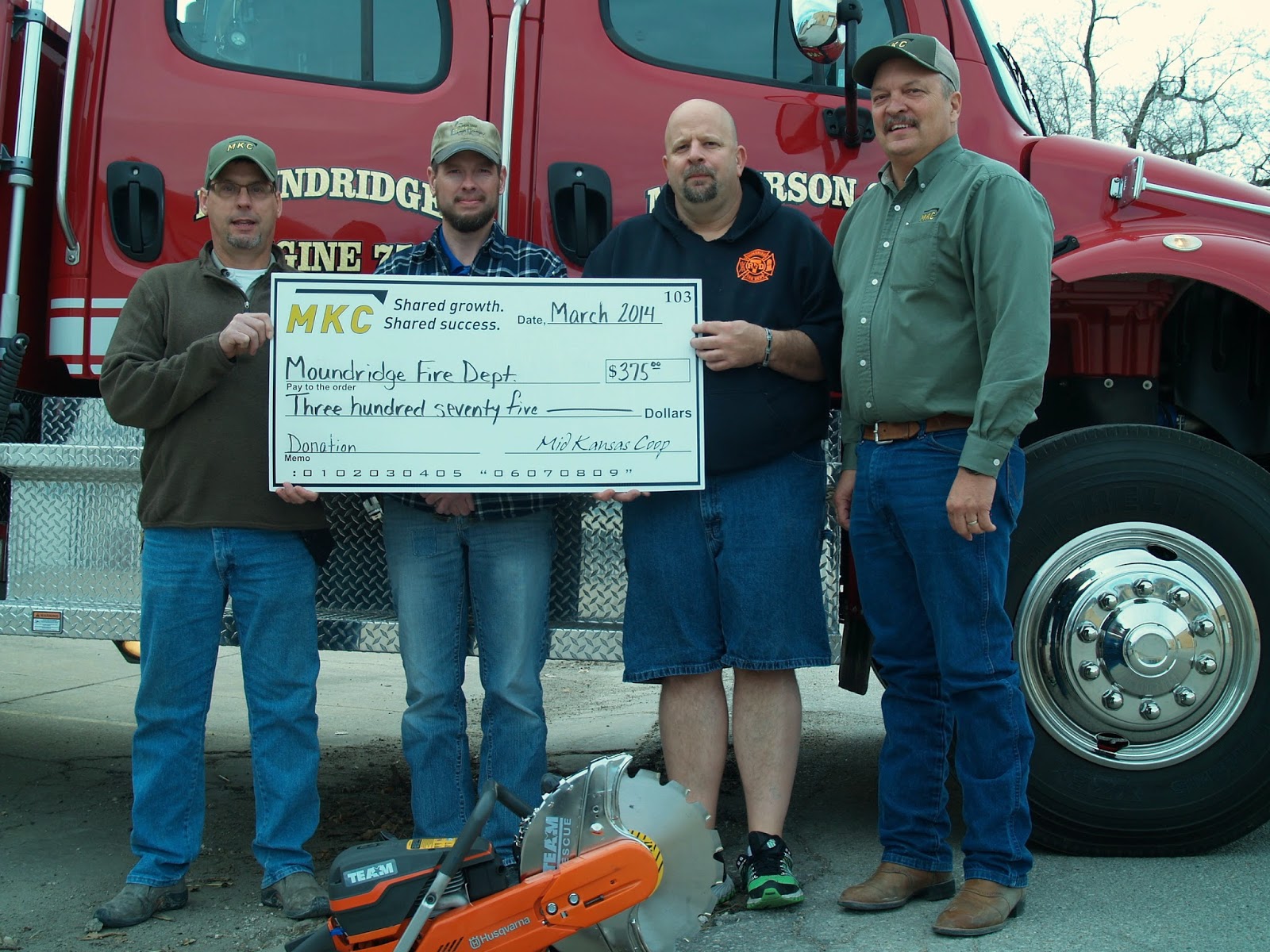
Recently MKC donated to the City
of Inman, McPherson County Sheriff’s Department and the Moundridge Fire Department. The donations helped the City of Inman with the completion of the interior on the new Community Building and the purchase of safety equipment for the McPherson County Sheriff's Department and Moundridge Fire Department.
According to Jim Toews, Mayor for Inman,
the new building replaces the shelter house built in 1959 as a community project. “We are very appreciative of MKC’s support,”
stated Toews. “This contribution will help with the purchase of tables and
chairs and other interior finish work.”
The new building will have the capacity to hold 250 people and has
already been secured for a number of large events not previously held in Inman.Dean Scott, McPherson County Sheriff’s Department Sergeant and SWAT Team Commander was very appreciative of MKC’s donation to help with the purchase of a mobile surveillance unit. “A device such as this will allow our officers to monitor a high-risk situation from a distance,” he said. “This will be very beneficial to the safety of our officers and the public.”
The donation to the Moundridge Fire Department assisted with the purchase of a K12 Vent Saw. The saw is used to cut vents in a roof, allowing smoke to escape from the structure.
Land O' Lakes matched the contributions to the Community Building in Inman and the McPherson County Sheriff's Department. Over the past five years, MKC has donated more than $300,000 to communities throughout central Kansas with the majority of the donations going to programs that focus on alleviating hunger, leadership development, ag education and community safety.
Thursday, February 27, 2014
Helping Farmers Manage Risk
By Nichole Gouldie, Communications Specialist
Risk is an
unavoidable element in the business of agriculture. Production can vary widely
year to year due to unforeseen weather and market conditions, causing wide
swings in commodity prices. But risk, while inevitable, is often manageable.
Following a
storm this past June, McPherson area farmer Dennis Friesen saw green snap
damage like he had never seen before. After the area received 80-90 mph winds,
he soon discovered the risk management decisions he had made with TMA and MKC
were bound to improve his return on his investment.
After looking
over his fields following the storm, Friesen immediately called his TMA Crop
Insurance Specialist, Danny Flynn. Within three days, the totaled corn field
was chopped and a short-season corn was planted. “Very quickly Dennis was able
to collect insurance, protect his revenue and pursue another crop,” Flynn said.
Once he
received word the corn crop was 70 to 80 percent damaged, Friesen worked with
Dusty Campbell, TMA grain marketing specialist, to make sure he would be okay
on his marketing strategy.
![]() |
Danny Flynn, crop insurance specialist for TMA, discusses
risk management strategies for 2014 with Dennis Friesen.
|
TMA provides
producers with a multitude of risk management offerings that can be customized
to fit their operations. The array of risk management strategies available to
producers allows the opportunity to place their attention on making buying and
selling decisions based off timing and profitability instead of price.
“There are a
number of tools available and widely used to manage the economic, structural
and environmental risks of farming,” said Devin Schierling, TMA grain marketing
manager.
Schierling
says
the local
cooperative plays an integral role in assisting customers manage their crop
input risk, just as the TMA specialist focuses on maximizing revenue through
grain marketing and crop insurance decisions. “This approach allows our
producers to focus on the timing of their marketing decisions,” he said.
“Depending
upon their needs, producers will have the ability to manage their farm’s risk
in multiple crop years by using traditional forward cash contracts, option
based contracts, and over-the-counter contracts,” Schierling said. “TMA
provides producers with a multitude of risk management offerings that can be
customized to fit their operations and grain contracts as the vehicle to help them
maximize their revenue potential.”
Although farms
vary widely with respect to crop mix, financial situation and other business,
timing and looking at trends is the most important part of creating a successful
risk management plan. Schierling encourages producers to focus on their farm as
an enterprise to allow them to make decisions based off revenue and not from an
individual price perspective.
While
producers often take the steps necessary to manage their risk, there are times
when it certainly pays off and the producer learns first-hand just how
important managing risk is to their operation.
Friesen stated
it was reassuring to have the specialists there to help make sure he was taking
the appropriate steps to make the insurance claim correctly.
“Dusty and
Danny worked together, and we worked with Jared Jones right away to check
availability of seed,” Friesen said. “I won’t find this type of customer
service with other companies.”
While crop
insurance is the most ubiquitous risk management tool used by farmers - 86
percent of total planted acres in 2012 were insured – there are other tools
many farmers use as well.
“Agricultural
practices, marketing and financial strategies are all critical in helping producers
manage their risk,” said Jared Jones, MKC field marketer. “The TMA and MKC
relationship provides numerous avenues for producers to manage their risk.”
The risk
management services at MKC include programs such as MKC’s risk 12-month forward
contracting on fuel, crop protection and nutrient products, and the double-crop
soybean revenue program.
Friesen says
he regularly works with TMA and MKC specialists to manage risk.
According to
Jones, the moment a producer decides to plant, the risk management cycle
begins. TMA and MKC work together to determine inputs, crop insurance and the
ability to market grain.
Friesen stated
risk management is a continuous cycle working with his insurance specialist,
grain marketing specialist and field marketer. “It all works really well
together,” he stated.
“Every one of our producer’s definition of a
successful risk management plan is different,” Flynn said. “Plans will
change depending upon the customer’s operation but the focus is always on
maximizing our producer’s revenue potential.”
Friday, February 7, 2014
Ag Organizations Partner to Save Lives
Over the past 50 years, more than 900 cases of grain engulfment have been reported in the U.S. with a fatality rate of 62 percent. In 2010, at least 26 U.S. workers were killed in grain engulfments - the highest number on record. The most tragic of all: grain engulfments are highly preventable.
Nationwide Agribusiness Insurance company is partnering with Farm Safety for Just Kids, Iowa FFA Foundation and others to increase awareness of the dangers of flowing grain and bring visibility to safety procedures that can save lives through an annual Grain Bin Safety Week beginning February 23.
Timed to bring safety awareness to the dangers of grain bins prior to planting season in much of the country, the week-long event will highlight a different component each of the seven days including grain management, bin hazard identification, bin and equipment design, bin entry, working safely in a bin, extraction/rescue and confined spaces beyond the bin.
Highlights of the week include:
- #AgChat on Twitter 7 - 9 p.m. CT, Tuesday February 25. (Be sure to include the hashtag #GBSW14 in your tweets.)
- On Wednesday, February 26, Nationwide Agribusiness will host a free, live webinar on grain safety that is open to everyone. Farmers and commercial grain handlers will gain valuable insight into the risks and hazards of grain bins, safe-work procedures, OSHA standards and more. Reserve your spot now at http://nwagcompanyevents.fugent.com/home/events.asp.
- Win safety equipment and training for your local fire department. The contest runs from January 1 to April 30. nationwide Agribusiness and NECAS have partnered to provide grain entrapment rescue training and a bin rescue tube (valued at $2,600) to one nominated fire department or emergency rescue squad. Official rules are available at GrainBinSafetyWeek.com.
Thursday, February 6, 2014
MKC Employees to Participate in National Wear Red Day
By Kerry Watson, Director of Communications
MKC employees will be adding a little color to their uniform on Friday as theyjoin others across the nation and wear red to help bring more awareness to heart disease. National Wear Red Day, held the first Friday of February each year, helps bring awareness to heart disease and its impact not only on women, but men as well.
Subscribe to:
Posts (Atom)