Showing posts with label Mid Kansas Cooperative Association. Show all posts

Wednesday, February 25, 2015

Inches, Not Just Acres

By Nichole Gouldie, Communications Specialist

For many producers, farming is measured in inches, not just acres. As Darcy Nickel and hundreds of other farmers begin preparing the soil or planting their crops each year, an increasing number are turning to the technology in precision agriculture to optimize their crop.

In fact, precision agriculture is becoming more of a regular practice that many farmers have integrated into their operation without considering it a form of precision agriculture anymore. With nearly every tractor, sprayer and combine utilizing GPS auto-steer systems and various monitors, precision agriculture is being implemented on more and more farms every day.

The changes in technology are exciting for Nickel, beginning his fifth year using
Benisch reviews field data with
Goessel area producer,  Darcy Nickel.
precision agriculture. Nickel is the first to point out that each field of his is different but with a number of services MKC offers for precision agriculture through the Optimal Acre Program, Ross Benisch, MKC precision agriculture specialist, and he can customize a plan for each field.


Precision agriculture uses technology to compile data for farmers so they can operate more efficiently, thus better managing production costs, increasing production and increasing profits. Essentially, it is a practice that uses detailed, site-specific information to accurately control and manage inputs, Benisch says.

Benisch said farmers traditionally spread uniform rates of fertilizers, seed and irrigation across their farms. One field may have several different soil types and fertilizer needs, he said, and the amount of bushels it would grow can vary significantly from acre to acre.

"Through the MKC Optimal Acre Program, precision agriculture uses technology and data the farmer owns to increase input efficiency and bushels per acre," Benisch says. "The goal is to help producers place their inputs for optimum return on investment."

Ten years ago, the market was focused heavily on GPS guidance for machinery because of the instant results the growers saw with improved in-field productivity, reduced operator fatigue and the ability to operate machinery for longer hours. "After GPS, it moved toward more site specific agriculture like the creating of variable rate prescriptions for inputs such as crop nutrients, lime, seed and irrigation water," he says.

"We take a practical approach to our precision ag," says Nickel, who grows corn, soybeans and wheat. "We use it as an overall management tool where it makes sense instead of using it on every acre."

Costs are a determining factor when choosing whether or not to use precision agriculture, but Benisch says farmers are quickly finding they can be profitable using the data that is collected. While there is cost involved to get started to gather the field data to make the variable rate prescriptions, the data can be used for several years before testing is needed again.

"Often, the increase in input efficiencies results in the data paying for itself," Nickel says. "With the help of MKC, our farm looks at the precision ag data we collect as an investment rather than an expense because of the many benefits we have seen on our own operation."

As for the precision ag services currently offered by MKC, Benisch says they like to start with grid sampling because it tests for many key factors including soil nutrients and pH which are vital for every crop grown. "With the grid sample results, we can then variable apply many products to increase application accuracy," he says. "MKC has the equipment to variable apply lime and crop nutrients so the farmer doesn’t have to own any extra equipment to take advantage of what grid sampling can offer."

As farmers keep records of this information year after year, patterns begin to emerge and the information gained from GPS technology becomes a valuable reference upon which to base vital management decisions.

Nickels says one of the most important purposes of the Optimal Acre Program is it gives them the opportunity to optimize their yield potential and effectively use crop inputs year after year after year.

"The more data a farmer collects the more we can customize each field to achieve maximum profitability over time," Benisch says. He recognizes not everyone has the same goals in mind so it makes sense to start with the important base layers of information and expand in the other services MKC offers. He also notes over time, the information that is valued for a particular field will most likely be collected and acted on, while other fields may not need the same layers of information to make good management decisions for the upcoming year.

"Each field is unique. The more pieces of data we have to help solve the yield puzzle, the more accurate we are going to be with our vrt prescriptions and the producer will have a greater return on investment," Benisch says. MKC uses the information the grower has and combines it with the field data collected to put together a customized program that best fits the growers operation, he says.

"It is often hard to tell people about our appreciation for precision agriculture," Nickels says. "I would encourage anyone who is interested in learning more to ask MKC."

Visit with an MKC location for more details on the Optimal Acre program and see how precision agriculture can benefit your operation.

Friday, January 2, 2015

Young Leaders Attend CHS New Leader Forum

By Nichole Gouldie, Communications Specialist

Twelve representatives from MKC attended the 2014 CHS New leader Forum, a program that builds next the generation's leaders for agriculture and rural America.

Those attending from MKC were Andy and Michelle Herman of Wheaton; Curtis and Betsy Patrick of Lindsborg; Hilary Worcester of Manhattan; Jameson Eichman of Wamego; Lucas Hamm of Salina; Nichole Gouldie of Inman; Nick Mazouch of Marquette; Russell and Tiffany Rezac of Onaga; and Thayne Rawson of Lindsborg.  

They were among 300 young producers from across the U.S. participating in the program December 3 - 5 in Minneapolis, Minnesota, in conjunction with the CHS annual meeting.

During the three-day forum, participants heard from leading experts on agriculture, leadership, cooperatives and risk management. Speakers included Carl Casale, president and CEO, CHS Inc.; Mark Mayfield, speaker author and ag ambassador; Dr. Greg McKee, director, Quentin Burdick Center for Cooperatives; and Terry McClure, board members, Nationwide and president, McClure Farms, LLC.

The New Leader Forum also featured a networking event with the CHS board of directors and participating in the 2014 CHS Annual Meeting, including workshops and the annual meeting business session.

CHS Inc. is a leading global agribusiness owned by farmers, ranchers and cooperatives across the United States, diversified in energy, grains, and foods.

Tuesday, November 18, 2014

Now's the Time to Sample Fuel Tanks

Properly sampling of fuel tanks is essential to protecting your diesel equipment investment. It's a good idea to sample your tanks at this time of year, so you can take care of any moisture and contaminant issues before the falling temperatures cause major disruptions. With the CHS fuel testing kits available at MKC, you'll receive a valuable lab report that outlines any fuel quality issues and provides problem-solving advice.
 
We recommend using a tank sampler kit with a portable hand-operated vacuum device because this method collects more accurate samples than using a water-finding paste. We offer trouble-free kits that are designed to help prevent spills and will work on any size vehicle, underground or above-ground tanks.
 
When pulling a sample, remember the majority of contaminants settle at the bottom of the tank - so it's crucial you pull samples from the bottom. Also, be sure to thoroughly clean and dry the jar and hose after each sample is taken.
 
As you gear up for winter, contact MKC's energy division at 888-442-0141 to order kits or request help with sampling.


Tuesday, September 9, 2014

Renewing Our Infrastructure

By Nichole Gouldie, Communications Specialist

Recognizing the need for new locations and making upgrades to current facilities allows MKC to keep pace with the growing needs of the producer. As MKC has continued to focus on renewing infrastructure this past year, the cooperative has invested more than $16 million dollars across its trade territory.

Jon Brown, director of facility management for MKC, has overseen each of the projects. “Meeting our customers’ needs and improving the customer experience has been the driver behind these projects,” Brown says. 

Thursday, September 4, 2014

Participants Sought for New Leader Forum

By Kerry Watson, Director of Communications

MKC is entering its tenth year of sponsoring participants to attend the New Leader Forum, held in conjunction with the CHS Annual Meeting. This year’s event will be held December 3-5 in Minneapolis, Minnesota.
Over the course of the forum, participants examine in-depth issues and challenges facing cooperatives, agricultural and rural America, as well as learn ways to build their leadership skills to benefit their cooperatives and communities. Sessions feature top-notch professional speakers and agribusiness experts. The conference is geared towards individuals and/or couples, ages 25 to 45 years.

Since 2004, MKC has sponsored 89 participants. Ben and Tina Schrag of Canton attended the event in 2013. "For me it was a great educational experience," said Ben. "I learned how MKC fits in with larger cooperatives’ grain distribution, not only in the United States, but internationally as well." Schrag also commented on the value of networking with other MKC customers who attended the event. "I didn’t know them before attending the Forum and still keep in touch with them today."

If you are interested in being considered for participation in the 2014 New Leader Forum, please contact a field marketer or Nichole Gouldie at 620-345-4119.

2009 Participants
(Left to right): Matt & Daisy Friesen, Josh & Emily Regier and
Mike and Angie Maloney.

2011 Participants
Back row: Kent Nichols, Devin Sheriling, Jon Brown
Front row: Amber Brown, Katie and Derek Sawyer, Doug Graber and Aaron Vogts.
 

Sunday, August 24, 2014

Legislative Staff Members Spend Day at MKC

By Kerry Watson, Director of Communications

In its inaugural Legislative Staff Day on August 15, MKC hosted five staff members from Kansas House and Senate offices providing a firsthand look at the breadth of services provided by MKC. The full-day event included discussions with MKC employees and a tour of facilities at Groveland and Canton.

"We know it’s critically important to host congressional staff so they can see up close the facilities and services we provide to our members and their constituents," said Dave Spears, vice president of marketing. "Staff members are often the first point of contact for the constituents of their members of Congress. This visit was a great opportunity for the staff to gain a better understanding of MKC and the cooperative system."

Mel Thompson, state agriculture representative for Senator Pat Roberts, noted having contacts in the industry is invaluable. "MKC is a class act. You’ve succeeded in the peaks and valleys," said Thompson. "Thanks for being a partner to serve your members and our constituents and representing agriculture."

 
Staff members attending the event included John Sachse and Judd Gardner with Senator Jerry Moran, Steven Howe with Congressman Tim Huelskamp, Rachel DeGarmo with Congressman Mike Pompeo and Mel Thompson with Senator Pat Roberts.

During the site tours, congressional staff gained a better understanding of how technology is used in the grain and agronomy industry.


Backrow (left to right): Ted Schultz with TMA, Devin Schierling with TMA, John Sachse with Senator Moran, Judd Gardner with Senator Moran, Steven Howe with Congressman Huelskamp and Dave Spears with MKC.  Frontrow (left to right): Kerry Watson with MKC, Rachel DeGarmo with Congressman Pompeo, Mel Thompson with Senator Roberts and Danny Posch with MKC.


Monday, July 7, 2014

Annual Meeting to Feature Bruce Vincent

MKC's 49th Annual Stockholders' Meeting will feature keynote speaker, Bruce Vincent, a third generation logger from Libby, Montana.

Vincent speaks throughout the United States and the world and often provides testimony on resource issues before Congress. He has been reported on by numerous publications and newspapers including The Wall Street Journal, New York Times, Los Angeles Times, and Washington Post. He has appeared on "60 Minutes" and participated in radio shows, documentary videos and news broadcasts throughout the nation and in several countries.

During Vincent's career, he has been awarded the national Timber Industry Activist of the Year, the Montana Timberman of the Year, the Sylvan Award for service to the national timber industry, and the Public Service Award from the Association of Consulting Foresters of America. He is this year's Women in Agriculture "Keeper of the Tenth" award winner, recipient of the Agri-Women's 2007 Veritas Award, and has been inducted in to the Libby High School Hall of Fame.

The annual meeting is scheduled for Thursday, July 24, at the Bicentennial Center in Salina. Reservations for the event are requested by July 17.  Click here to register.

Friday, June 20, 2014

Mike Becker Seeks Election to MKC Board of Directors

Three positions on the MKC Board of Directors will be decided by a vote of the membership at the 49th Annual Stockholders' Meeting on July 24. Mike Becker is seeking election to represent District 2.
 
Becker is honored to be a candidate for the MKC Board of Directors. He and his wife, Sarah, own a diversified crop and livestock operation southwest of Lindsborg along the Smoky Hill River where the majority of their farm ground is located. They raise corn, soybeans, wheat and sorghum, with over half the acres irrigated. Their livestock operation includes 250 commercial cows and half-interest annually in 200 bred heifers which they develop, AI, calve and sell as pairs. Their grass is located in six counties so they travel long and hard.

Wednesday, June 11, 2014

MKC Hosts Dignitaries

By Melissa Woeppel, Communications Intern

MKC’s Manhattan location recently hosted Congressman Tim Huelskamp and Mr. Jack J.C. Yang, director general of the Taiwan Consulate for a round table discussion with members from the Kansas Grain and Feed Association, the Kansas Pork Association, Seaboard Foods and the Kansas Cooperative Council. Discussion centered on trade between Taiwan and Kansas and opportunities for improvement.

Following the roundtable discussion, MKC’s Vice President of Eastern Operations Darin Marti led a tour of the facility, explaining the benefits of the cooperative system. "We can’t offer our customers anything different except service, so our goal is to provide exceptional service," Marti stated.

The use of genetically modified organisms, GMOs, was also a topic of discussion on the tour. According to Congressman Huelskamp, "the approval process for GMOs in the United States is the most stringent in the world, ensuring the safest products."

Utilizing modern technology allows for safer and cheaper agricultural practices.

"We can’t continue to use technology from 30 years ago," Marti added. "With improvements in corn hybrids, we’ve learned how to grow corn better, which results in larger yields, safer products and a profit for the producer."

Congressman Huelskamp serves on the Veterans’ Affairs Committee, the Small Business Committee, the Subcommittee on Agriculture, Energy & Trade, the Subcommittee on Health & Technology, and the Subcommittee on Contracting & Workforce. As an ambassador for Kansas agriculture, Congressman Huelskamp is excited about the prospects for growing the markets for Kansas products in other parts of Asia, including in Vietnam and Japan.

Monday, March 17, 2014

Caring for Our Communities

By Kerry Watson, Director of Communications

Concern for the community is one of the seven principles of the cooperative system.  For MKC, it’s much more.  “We believe our donations, participation in community events and the number of hours employees donate back to their communities through volunteerism is what keeps our communities strong,” states Dave Christiansen, President and CEO for MKC.  “It’s about keeping our rural communities viable for future generations.”

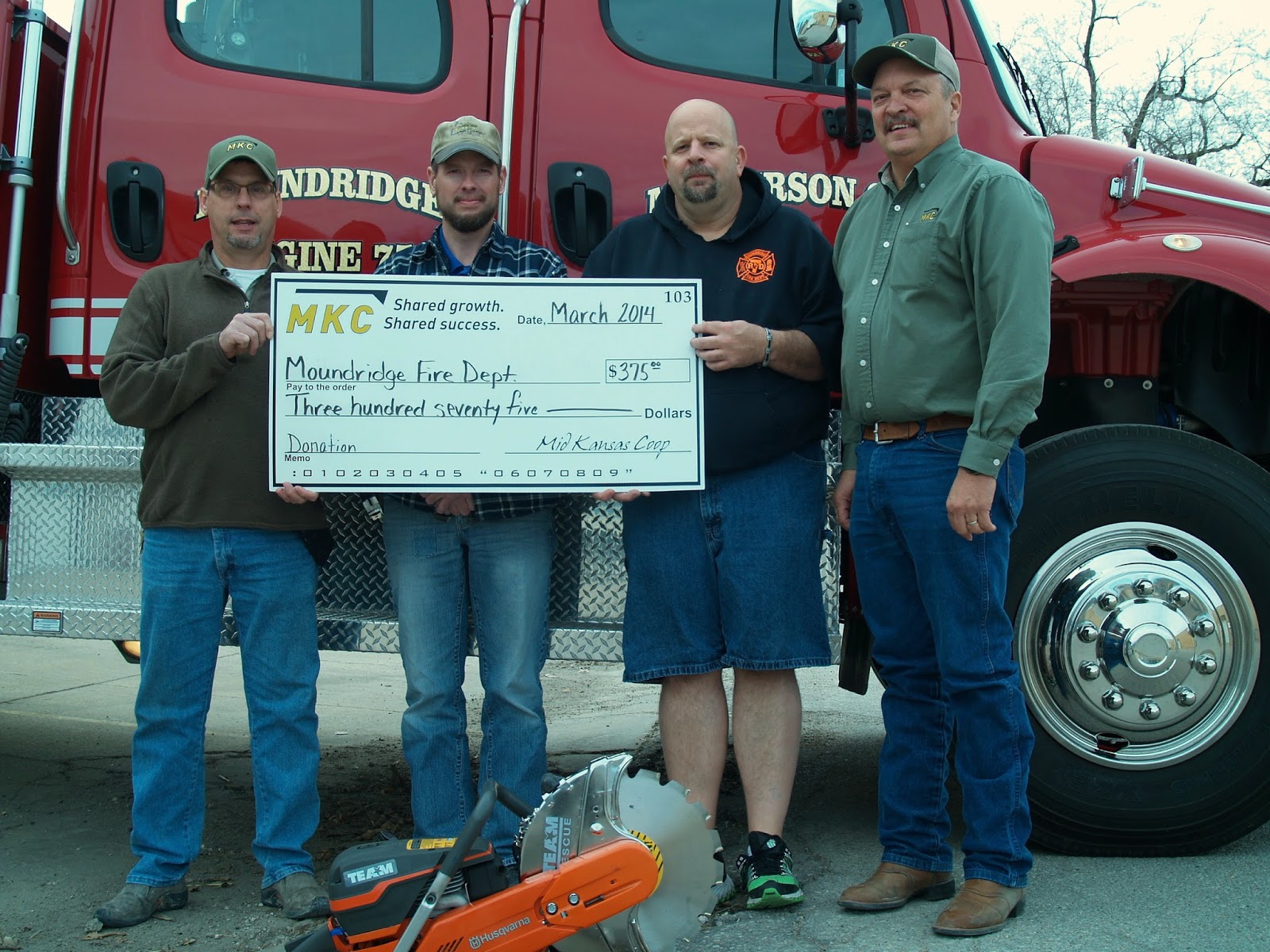
Recently MKC donated to the City of Inman, McPherson County Sheriff’s Department and the Moundridge Fire Department.  The donations helped the City of Inman with the completion of the interior on the new Community Building and the purchase of safety equipment for the McPherson County Sheriff's Department and Moundridge Fire Department.

According to Jim Toews, Mayor for Inman, the new building replaces the shelter house built in 1959 as a community project.  “We are very appreciative of MKC’s support,” stated Toews. “This contribution will help with the purchase of tables and chairs and other interior finish work.”  The new building will have the capacity to hold 250 people and has already been secured for a number of large events not previously held in Inman.


Dean Scott, McPherson County Sheriff’s Department Sergeant and SWAT Team Commander was very appreciative of MKC’s donation to help with the purchase of a mobile surveillance unit.  “A device such as this will allow our officers to monitor a high-risk situation from a distance,” he said. “This will be very beneficial to the safety of our officers and the public.”
 
The donation to the Moundridge Fire Department assisted with the purchase of a K12 Vent Saw. The saw is used to cut vents in a roof, allowing smoke to escape from the structure. 

Land O' Lakes matched the contributions to the Community Building in Inman and the McPherson County Sheriff's Department.  Over the past five years, MKC has donated more than $300,000 to communities throughout central Kansas with the majority of the donations going to programs that focus on alleviating hunger, leadership development, ag education and community safety. 

Thursday, February 6, 2014

MKC Employees to Participate in National Wear Red Day

By Kerry Watson, Director of Communications

MKC employees will be adding a little color to their uniform on Friday as they
join others across the nation and wear red to help bring more awareness to heart disease. National Wear Red Day, held the first Friday of February each year, helps bring awareness to heart disease and its impact not only on women, but men as well.

Friday, January 31, 2014

Relevance - Standing the Test of Time

By Dave Christiansen, President and CEO
Regardless of what cooperative I happened to be serving at the time, it’s certainly been interesting over the years to pause and reflect on the relevance we possessed and to whom. The first time I recall listening to a discussion about relevance was in the mid-'70s when the co-op I was working for achieved record sales. That certainly seemed a big deal at the time and I recall our vendors treated us as such. As an employee group we took a lot of pride in what our relevance meant we could deliver to our customers. At the time, little did we know the bar to be considered relevant in the agricultural industry was beginning a very rapid ascent.

Monday, January 6, 2014

Delivering a Helping Hand

By Nichole Gouldie, Communications Specialist

July through August is a busy time for Kansas farmers. Throw in record-setting rainfall, and the pressure is multiplied many times over for producers, meaning busy times for their cooperative. MKC saw this pressure this past summer but was relieved to know some friends up north were there to deliver a helping hand.
 
"This year was a very unusual year for our trade territory due to all the rain we had in late July and early August," said Erik Lange, Director of Southern Operations for MKC. "Generally by mid-August we are beginning to get busy with pre-plant wheat fertilizer applications but due to very wet soil considerations we were unable to start in a timely fashion. By the end of the second week of August, Steve Peterson and I had begun to talk about alternative methods to get our customers taken care of. It came to mind we should call South Dakota Wheat Growers and see if they had people or assets available to help us get caught up."
 
According to Lange, this relationship started with a phone call with Phil Gilbert, SDWG regional manager. Over time, Gilbert and Lange have built a relationship, continuing to find ways to help the other organization when they can.
 
"It isn’t easy to move rigs, but people and tender trucks move quickly," Lange said. "We looked at our situation and realized if we could just tender our existing equipment better we could cover more acres."
 
According to Lange, MKC consciously understaffs tender drivers because it is a seasonal task and normally elevator employees can be relied on to fill in. This year fall harvest started and the elevator employees were engaged in servicing grain customers at the same time fertilizer needed to be applied. "SDWG’s assistance worked out great as they were in their very slow time of the year and had drivers and extra tender trucks underutilized," he said. "Overall, SDWG sent 11 different drivers and four tender trucks to Kansas."
 
Prior to the SDWG team traveling to Kansas, six dry tender trucks, three dry rigs and nine employees of MKC traveled to South Dakota in May 2011. Over this three-week period, the MKC crew helped SDWG meet their customer’s fertilizer application and delivery needs in a year that the weather provided unusual challenges.
 
SDWG began as a state wheat pool in 1923 and has grown into one of the most successful cooperatives in the United States. They are an agronomy cooperative in the heart of the James River Valley of South and North Dakota. Owned by the customers it serves, SDWG exists to provide value for customer owners from Interstate 90 to Interstate 94 and the Missouri River to Interstate 29.

Friday, January 3, 2014

Schmidt Retires After 38 Years in Industry

After 38 years of service to the cooperative industry, John Schmidt officially retired on December 19.

"I have enjoyed working for and with our customers," Schmidt said. "They have brightened my day many times."

Schmidt said the bucket list after retirement is pretty long and includes traveling, catching up on projects that have been put off for a long time and doing some volunteer work in a couple of areas.

"It has been a pleasure to work with all the employees of MKC," Schmidt said. "I will be in the area for the foreseeable future, so I am sure I will be able to visit with some of you occasionally."

MKC wishes John well as he enjoys retirement. We hope he'll stop in and say "hi" from time to time!

Saturday, December 28, 2013

Children "Adopted" in Angel Tree Program

 By Nichole Gouldie, Communications Specialist

Christmas for more than 200 families was a little merrier thanks to the generous donations to the Salvation Army's Angel Tree Program.

It was the second year for the program at MKC, where employees adopted a child - buying them items for the holidays.

"The MKC Angel Tree Program was very successful again this year," said Matt Henderson, Longford location manager. "MKC employees helped to brighten the Christmas of around 200 children."


A group of employees load the gifts
collected in Moundridge.
In addition to employees personally donating items to the program, the Abilene location volunteered to run the Dickinson County Angel Tree program.

"Without their help this program would not have happened," Henderson said.  The Abilene location helped 150 children this year.

Henderson added the families that have received gifts through the MKC Angel Tree have expressed their thanks in many ways and their tears of joy at the sight of the presents they receive is priceless. "It makes me proud to be a part of a company that is so willing to give so much back to their communities," he said. 
Dominique Hill and Brent Floerke load
the gifts collected in Benton.


Thursday, November 14, 2013

MKC and Frontier Ag moving forward with merger discussions

The boards of directors for Frontier Ag and MKC have unanimously approved to move forward with the processes required to merge the two cooperatives. The cooperatives announced in September their plans to explore the potential of an alliance.

Board members from both cooperatives met earlier this week
to discuss the merits of a merger.
Frontier Ag President and CEO, Brad Cowan, commented the boards and management teams of both organizations spent the past sixty days completing the due diligence necessary to get to this point.


"We felt the time was right to pursue a merger," stated Cowan. "Combined we have the potential to position ourselves strategically for the future, creating tremendous opportunities for our members."

MKC President and CEO, Dave Christiansen, noted the cooperatives share a similar culture and vision, are comparable in product and service offerings, and are financially sound. "Both cooperatives focus on improving customer experience" stated Christiansen. "Together we have the potential to increase our relevance in the industry which will leverage our vendor relationships." The benefits this will deliver to our stockholders, employees, customers and communities are significant. "

Although the boards of both co-ops have endorsed the idea of a merger, each membership will be asked to approve it.

About Frontier Ag: With annual sales of $490 million, Frontier Ag, Inc. is a full-service cooperative, offering grain, feed, agronomy, energy, and transportation products and services to over 5,700 members in eleven (11) counties throughout northwest Kansas.

About MKC: With annual sales of $450 million, MKC is a full-service cooperative offering grain, feed, agronomy and energy products and services to over 6,400 members in eleven (11) counties throughout central Kansas.


Wednesday, November 13, 2013

MKC, CoBank and Land O' Lakes join forces to support ag education

By Kerry Watson, Director of Communications

Supporting ag education has always been important to MKC. Whether we are joining forces with local schools to teach children how agriculture affects their life every day or providing financial assistance to schools to make sure students have access to programs and educational opportunities outside of their classroom, we want to support those who share our passion for ag education.

Dave Christiansen, MKC President & CEO noted that MKC and its employees take pride in supporting the development of our future leaders. "We feel the groups we choose to support says a lot about our company."

The Walton 21st Century Rural Life Center is just one of the area schools that MKC likes to support. The school first caught the attention of MKC in 2009. Just a few years earlier the school was close to being closed due to declining enrollment. They transitioned to a functioning charter school in the fall of 2007, a good fit for the surrounding community because of its strong agricultural roots. Now the school integrates agriculture into all areas of its curriculum.

The school’s popularity has grown along with outside support to keep it and now there is a waiting list to get in to the school. Moving forward with expanding the classrooms, the school has relied on outside contributions to help offset those costs. In an interview last year with the school’s principal, Natise Vogt, commented the growing pains and state budget cuts makes support from people like MKC even more vital.

Michael Walton, CoBank Representative (center),
and Jeff Naysmith, MKC Representative (at right),
present a donation to be used for the school's
building project.
In recent years the school has also captured the attention of Land O’ Lakes and CoBank, thanks to MKC. Both entities have matched MKC’s donations to the school helping to donate over $14,000 since 2009.

Robert Engel, CEO for CoBank, commented on MKC’s commitment to the school while improving the quality of life in their communities. "We’re delighted to join with MKC in support of the Walton Rural Life Center."


Sunday, October 13, 2013

Why we focus on growth

By Dave Christiansen, President and CEO

I first shared the following article in August, 2012 and felt the message to be timely and worth repeating.

I always find it interesting when I run into someone who asks the question, "Why focus on growth?". Somehow the vision the founders had for growth, from the day this company began, went from being an expectation to being assumed. Today, active growth is at times thought of with negative connotations.

At the time the co-op was organized, the passion for meeting the constantly changing needs of farmers’ expectations may not have been referred to as growth. However, I’m sure our founders had certain expectations of the co-op’s ability to meet the changing needs of the growers. At that time, they built elevators and purchased equipment that satisfied the needs of the day and new assets were surely designed with the future in mind.

Wednesday, September 18, 2013

Engaging youth in agriculture

By Nichole Gouldie, Communications Specialist

Now that school is back in session, kids are being immersed in reading, science and math. Outside the classroom at the Kansas State Fair, children had the opportunity to experience first-hand the importance of agriculture.

Last Friday I had the chance to volunteer with the Kansas Beef Council (KBC) at Agriland. Agriland, an interactive exhibit in the Pride of Kansas building, provides youth and adults the opportunity to learn the importance of agriculture and the impact it has on their everyday lives.

Guests visiting Agriland traveled through learning areas for beef, dairy, soils, grains, stewardship and nutrition/dietary guidelines. In those areas we taught visitors about how crops and livestock provide us not only with food, but also with numerous products we use in our everyday lives—from basketballs to bubble gum. In the livestock area, fair goers took photos with the cutouts and weighed themselves on a scale, comparing themselves with the weights of a calf or a bushel of grain. In the grains area children immersed their hands in buckets of grain including corn, soybeans, wheat, sorghum, sunflowers and others. A favorite for the kids was the experience of "driving" a combine.

Tuesday, September 10, 2013

The Cooperative Advantage

By Nichole Gouldie, Communications Specialist

There are reward cards and punch cards. You may have coupons or store cash but very few
MKC Field Marketer, Jared Jones, personally
delivers patronage checks to MKC members,
Jim Schmidt and Ben Schrag.
businesses offer an incentive quite like your cooperative. MKC returns profits to its customers, the members who use its services. That is the cooperative way of doing business.


“Doing business with MKC definitely has its rewards,” said Jim Schmidt, McPherson County producer. “Not only do we get quality and personal expertise, but facilities continue to be improved or new ones are being built, and at the end of the year we see a patronage check for our business.”

MKC Chief Financial Officer, Danny Posch, said we are often asked what does a cooperative do with its net earnings. “One of the primary uses is allocating a portion back to our members based on the business they did with the cooperative during the business year,” he said.