Thursday, May 29, 2014

Input Finance Program Creates Win-Win Situation for Producers

By Nichole Gouldie, Communications Specialist

To help producers obtain the financing their operation needs, MKC in conjunction with the Cooperative Finance Association, Inc. (CFA), provide reliable financial products and services to its members for all of their fertilizer, chemical, seed and petroleum needs.

"CFA is a valuable tool for any cooperative member," said Keith Kincaid, co-owner of S&K Partners near Haven. "CFA is convenient, user-friendly and competitive to any financing program in the industry."

Tuesday, May 13, 2014

MKC Increases Investment Opportunities To Public

By Nichole Gouldie, Communications Specialist

Based on the success of the MKC investment program, the board of directors has voted to increase the amount of the investment opportunity for patrons of MKC. The program is currently open for investments.

“The financial strength and stability of MKC remains extremely strong and we are continually looking for ways to position ourselves well into the future,” said Danny Posch, MKC chief financial officer. “We believe the investment program truly provides a win-win opportunity for investors and MKC alike. By working together, we will continue to ensure we are in a position to take advantage of opportunities in the marketplace together with lessening the reliance on external funding sources to meet the working capital needs of the cooperative.”

There are two separate types of programs offered. The Certificate of Indebtedness program is a certificate written for a specified period of time. This program offers a 3.5 percent fixed interest rate on a three-year note, 4.0 percent fixed interest rate on a four-year note and a 4.5 percent rate on a five-year note.

The Demand Note program works much like a standard short-term investment account. Money can be transferred in and out of the account in a certificate that will each earn a rate of return that is very competitive in today’s marketplace. For the Demand Note program, the variable interest rate is currently at 2.5 percent and can be transferred or converted to a Certificate of Indebtedness.

Investors must be Kansas residents and an MKC stockholder. The limit of investment per investor is $300,000. Interest is paid annually on July 1 for both investment programs.

Interested participants of the investment program are encouraged to contact Laurie Thiesen, MKC accounts payable manager, at 620-345-4116 or lthiesen@mkcoop.com.

Monday, April 28, 2014

How will the New Farm Bill Affect Crop Insurance Coverage?

By Nichole Gouldie, Communications Specialist

After two years, the 2014 Farm Bill became a law on February 7. Also known as the Agricultural Act of 2014, the law is wide ranging but a common question on many farmers’ minds is how the new Farm Bill will affect their crop insurance coverage.

Recently, Team Marketing Alliance (TMA) hosted informational meetings for producers about how the farm bill actually affects the farm. With guest speaker, Kane Adams, regional marketing manager for Diversified Crop Insurance Services, TMA shared how they have the tools to help producers make an educated decision related to crop insurance included in the 2014 Farm Bill.

“Like TMA always does, they will work from your farm's history to determine your crop insurance needs,” Adams said. “It isn’t a one-size fits all approach.”

Effective for 2014, direct payments, the counter-cyclical payment program, ACRE program and the Sure Crop Disaster program will be eliminated.

“The 2014 Farm Bill’s commodity title requires producers to make an important decision related to crop insurance, whether to sign-up for one of two versions of the Agriculture Risk Coverage (ARC) program or the Price Loss Coverage (PLC) program,” Adams said.

The decision is made for each farm enrolled with the Farm Service Agency. The choice of program is a one-time decision to be made by a deadline not set currently. Adams estimates this sign-up not to be until late fall-winter or early 2015.  “The decision cannot be changed during the five-year life of the 2014 Farm Bill”, Adams said. “This is why it is very important for all TMA customers to work with their crop insurance specialist to make an educated decision about the two programs that is best for their operation.”

For producers just now learning about these crop insurance coverage options, TMA Crop Insurance Specialist Danny Flynn says the positive is you don’t have to make a decision today about the programs. “We have some time to make the decision and TMA has the tools and knowledge to help you make this decision.”

To learn specifically about the ARC and PLC programs, click here.

Kane noted while federal crop insurance saw an increase in the budget of $6 billion, most areas of the farm bill were cut in dollars. The budget was reduced by $23 billion total with cuts of $9 billion in the Supplemental Nutrition Assistance Program, commodity programs reduced by $14 billion and conservation lost $4 billion. He also commented food stamps and nutrition are nearly 80 percent of the 2014 budget.

Josh Roe, economist with the Kansas Department of Agriculture, has shared an overview of the 2014 Farm Bill and some of the impacts the bill will have. Click here for a fact sheet about the 2014 Farm Bill and here for a summary and impact of the bill put together by Josh Roe.

To learn more about crop insurance coverage or the 2014 Farm Bill, contact a TMA crop insurance specialist today.

Friday, April 25, 2014

Scholarship Recipients Announced

MKC is pleased to announce the recipients of its 2014 scholarship program. Ten
area high school seniors and eight college students have been selected to receive a $1,000 scholarship for the 2014-2015 academic year. Since 2008, a total of $45,000 has been awarded through MKC’s scholarship program.

More than 100 high school students and nearly 40 college students submitted applications. "The number of applications made the selection process difficult," said Nichole Gouldie, communications specialist for MKC. "By helping our local students pursue their educational goals, we are investing in their future, as well as the future of our local communities."

This year’s scholarship program was the first year to include a college-level age group. In addition, the dollar amount to high school seniors was increased from $500 to $1,000.

Scholarship recipients were selected based on academic achievements, honors, leadership, and school and community activities. Along with the application, students were asked to submit an essay addressing the value of the cooperative system.

High school students awarded scholarships are: Jacob Dailey, Canton-Galva High School; Justin Schmutz, Ell-Saline High School; Reece Hiebert, Goessel High School; Kristen Knackstedt, Inman High School; Trevor Smyres, Little River High School; Nicholas Meyer, Marion High School; Greg Schlickau, Pretty Prairie High School; Anneliese Reinert, Smoky Valley High School; Taylor Green, Southeast of Saline High School; and Savannah Sherwood, Southeast of Saline High School

College students awarded scholarships are: Nick Wineinger, Kansas State University; Austin Hiebert, McPherson College; Luke Snider, Kansas State University; Kristine Larson, Kansas State University; Spencer Yenni, Hutchinson Community College; Melissa Woeppel, Bethany College; McKayla Brubaker, Kansas State University; and Ashley Murrell, Elementary Education.

Thursday, April 3, 2014

MKC Employees Host Third Annual Food Drive

By Kerry Watson, Director of Communications

The statistics for food insecure homes in Kansas are staggering. According to a study released March 31, 2014 by the Kansas Food Bank and Feeding America, the nation’s largest domestic hunger-relief organization, the food budget needed by families struggling with hunger in Kansas each year is an estimated $164,968,840.

Throughout the month of April, MKC employees are joining together to help fill the shelves of area food banks through their third annual food drive, "Together We Can Fight Hunger".

"We know supplies for area food banks can be stressed during the summer," said Adam McDaniel, member of the MKC Community Involvement Committee. "Through a collective effort, we can make a meaningful difference for so many families in our area."

Last year, MKC employees collected 12,403 pounds of food and donated $15,000 to nine food banks throughout central Kansas. "Our goal for this year is to collect 15,000 pounds," McDaniel said.

MKC employees invite the public to join them in their food drive by dropping off non-perishable food items at any MKC location by April 30. Together we can fight hunger in our communities!
 

Monday, March 17, 2014

Growing With a Purpose

By Nichole Gouldie, Communications Specialist
What happens when something grows? It changes, doesn’t it?  A wheat seed looks different after being in the ground for a month and livestock will someday reach an age of weaning.

“If our co-op was going to survive in today’s world, it was going to have to grow,” said Tom Hauschel, Heartland Co-op CEO. “We realized change was necessary for us to compete in the increasingly challenging marketplace.”

Since the early days of the 1900's, Central Iowa farmers knew they needed a place to market their grain for a fair price.  Now, over 100 years later, Heartland Co-op has evolved into the cooperative it is today with 63 locations with operations in grain handling and marketing, fertilizer and application, agriculture chemicals and application, livestock feed and processing, agriculture energy products and propane.                                 

At each benchmark during the past 100 years, Heartland looked at the future needs of its members and chose growth over stagnation. The old, original elevators served the needs of those turn-of-the-century farmers who unified in order to put some clout in their grain marketing. “We're still doing everything we can to give Heartland-area farmers a voice in the future of agriculture amongst the growth that was attributed to our success,” Hauschel said.

Heartland believes in differentiating themselves from the competition by providing unique, value-added and innovative solutions to customers. Currently they serve more than 5,300 members and conduct business with them and others in one of the 63 communities across the state of Iowa.

The "original" Heartland Co-op was formed in 1987 with a merger of three cooperatives with facilities in Panora, Dallas Center, Minburn and Granger.

The Heartland Co-op that exists today was formed in 1993 with a merger of the "original" Heartland Co-op, Alleman Cooperative Company, Mitchellville Cooperative, and the facilities previously owned by Avon Grain Company at Carlisle and at East 18th Street in Des Moines. According to Hauschel, 17 mergers and acquisitions have occurred since 1993 creating the nationally recognized cooperative they are today.

A merger in 2007 truly changed the dynamics and earnings of the cooperative. “It gave us much better market arbitrage, asset utilization, access to capital, purchasing power, operating efficiency and much more,” Hauschel said. “All of those elements coming together improved cash flows and allowed Heartland Co-op to make meaningful improvements to serve the members.”

In addition to increased earnings, Hauschel said mergers have allowed their cooperative to attract and retain top-end talent. The ability to draw the attention of very talented people is a tremendous advantage. People will make a significant difference in returns to members while allowing the cooperative to be competitive in the market place, he said.

For Heartland members, growth has created a more viable, sustainable cooperative system. In addition, Hauschel believes it gives them better purchasing power and the ability to make meaningful improvements at their locations for better member services including speed, space and equipment. “We spend more money at an individual location than the prior cooperative had for a capital budget 10 years ago,” Hauschel added.

The geographic diversity has benefited Heartland as well. “You aren’t so reliant on one location,” Hauschel said. The western region of Heartland had record yields this past year while the northern footprint had one of the worst years in history. “Not having all the eggs in one geographic basket spreads out the cooperative’s risk,” he said.

Many of the earlier mergers were economically driven for Heartland Co-op. Hauschel added the board then witnessed and saw the difference in customer service, earnings and the difference in the talents they hired. “They continued to see all of the things we were missing before because we were too small or didn’t have the capital to be a competitive partner to our members”, Hauschel said.

According to Hauschel, a fear regarding growth of Heartland members has been there will be no competition. But in today’s market place, he said there is no lack of competition. “The bigger fear would be not having a viable cooperative system for the future,” he said.

While growth and change have been two constants for many other cooperatives across the country, mergers, consolidations and acquisitions have not been a strange occurrence for cooperatives throughout Nebraska and Iowa. In 1994, Iowa had 256 cooperatives. Today, they have 59 cooperatives. There are 55 agricultural cooperatives across Nebraska today.

Hauschel said there have been many changes as they reflect upon the past of Heartland Co-op. “We expect the trend of growth to continue, but growing with a purpose is more important than ever.”

Editors note:  MKC was formed in 1965 through a merger with of three neighboring cooperatives in Moundridge, Buhler, and Groveland. Just like Heartland Co-op, MKC has grown in size and territory through mergers and acquisitions since it founding. Most recently in a special meeting on Thursday, March 6, the membership of Farmers Cooperative Association approved a merger with MKC in an overwhelming 91% vote of approval. The merger will take effect June 1, 2014.


Caring for Our Communities

By Kerry Watson, Director of Communications

Concern for the community is one of the seven principles of the cooperative system.  For MKC, it’s much more.  “We believe our donations, participation in community events and the number of hours employees donate back to their communities through volunteerism is what keeps our communities strong,” states Dave Christiansen, President and CEO for MKC.  “It’s about keeping our rural communities viable for future generations.”

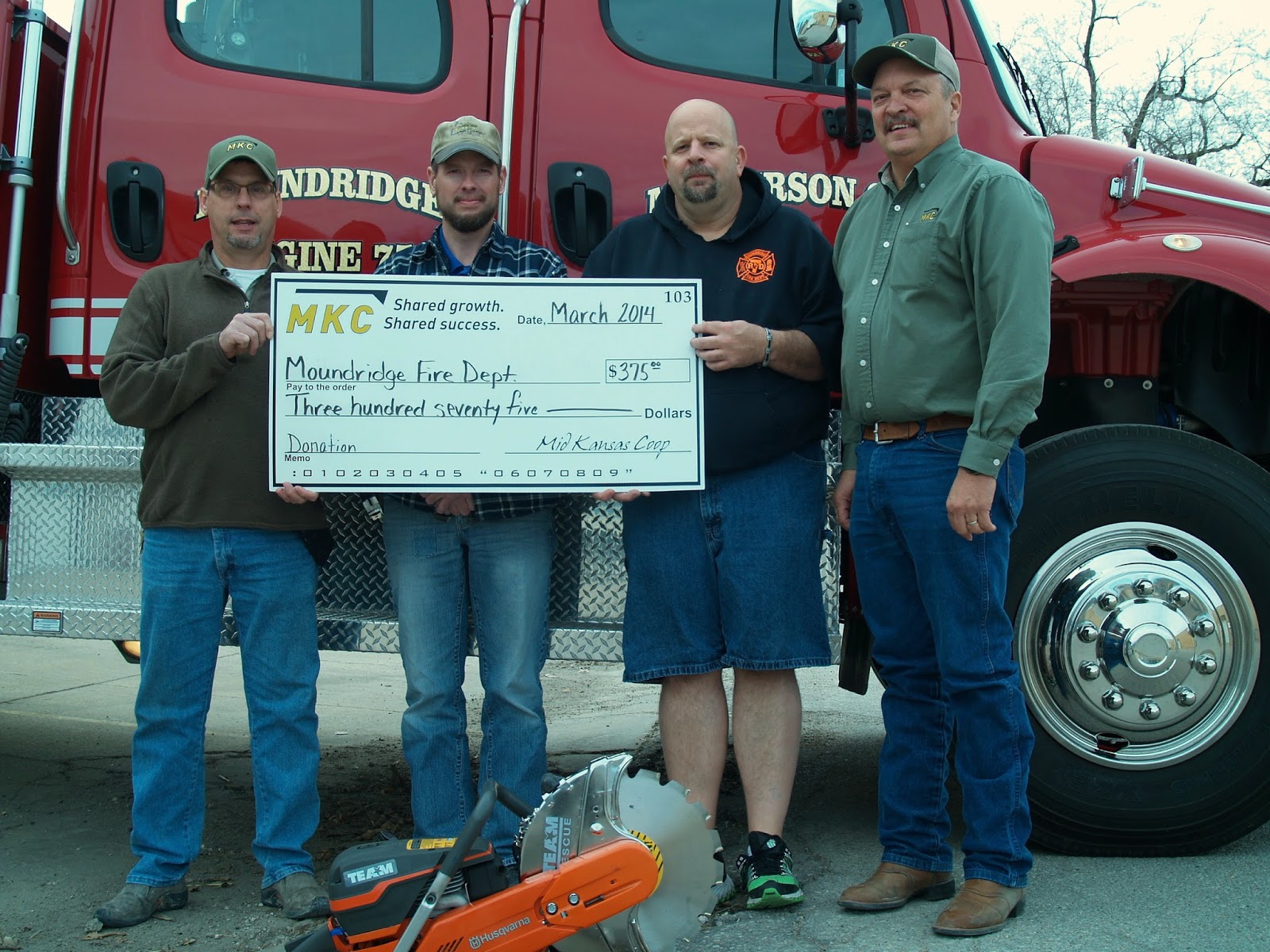
Recently MKC donated to the City of Inman, McPherson County Sheriff’s Department and the Moundridge Fire Department.  The donations helped the City of Inman with the completion of the interior on the new Community Building and the purchase of safety equipment for the McPherson County Sheriff's Department and Moundridge Fire Department.

According to Jim Toews, Mayor for Inman, the new building replaces the shelter house built in 1959 as a community project.  “We are very appreciative of MKC’s support,” stated Toews. “This contribution will help with the purchase of tables and chairs and other interior finish work.”  The new building will have the capacity to hold 250 people and has already been secured for a number of large events not previously held in Inman.


Dean Scott, McPherson County Sheriff’s Department Sergeant and SWAT Team Commander was very appreciative of MKC’s donation to help with the purchase of a mobile surveillance unit.  “A device such as this will allow our officers to monitor a high-risk situation from a distance,” he said. “This will be very beneficial to the safety of our officers and the public.”
 
The donation to the Moundridge Fire Department assisted with the purchase of a K12 Vent Saw. The saw is used to cut vents in a roof, allowing smoke to escape from the structure. 

Land O' Lakes matched the contributions to the Community Building in Inman and the McPherson County Sheriff's Department.  Over the past five years, MKC has donated more than $300,000 to communities throughout central Kansas with the majority of the donations going to programs that focus on alleviating hunger, leadership development, ag education and community safety.